
Library document
The Aspect Model
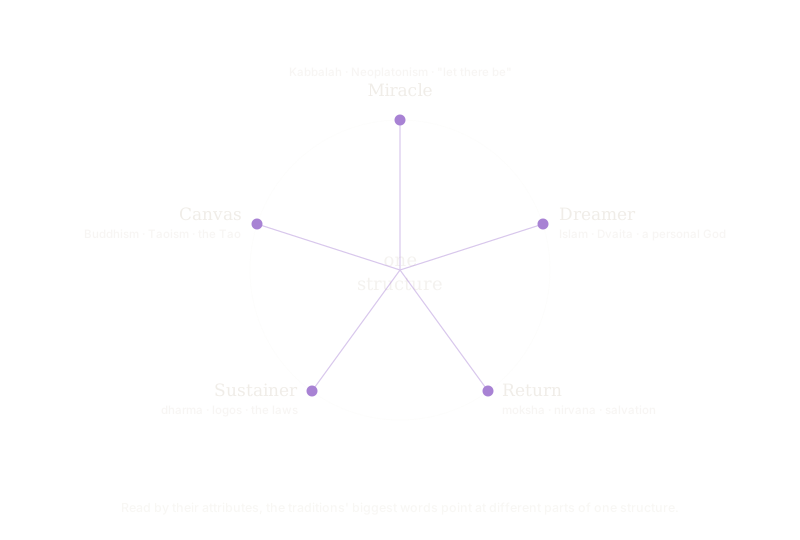
Shared vocabulary is not shared reference. Read by their attributes, the great terms of the traditions sort into distinct aspects of one structure (canvas, dreamer, miracle, sustainer, return), which is why apparently contradictory traditions can each be right about a different part. The aspects, the dissolution mechanism, the internal precedents, the discipline, and sources.
The post How the Religions Could All Be Right is the readable version. This is the rigorous backing.
The core claim FRAMING
The same word in two traditions can name two different things. When they reach for their largest words, each may be pointing at a different part of one structure. Sorted by their attributes, by what each tradition says the referent is actually like, the great terms fall into distinct aspects.
The aspects
| Aspect | What it is, by attributes | Where the traditions point at it |
|---|---|---|
| Canvas | The impersonal ground: no attributes, no will, nameless, formless | Tao (the unnameable); nirguna Brahman; Dharmakaya; Ein Sof; Eckhart's Godhead beyond God; Plotinus's One |
| Dreamer | A creator consciousness with intent, a mind | The personal God of the Abrahamic faiths; Ishvara / saguna Brahman; the Platonic craftsman |
| Miracle | The event from no-thing to something | "Let there be"; the Logos, the Word; Om as first sound; the tzimtzum, a withdrawal to make room |
| Sustainer | What holds the order in being and runs the laws | Dharma; the Logos as ordering principle; the cosmic dance |
| Return | How a part rejoins the whole | Moksha; nirvana; salvation; the Neoplatonic ascent (henosis) |
Each row is FRAMING: the mappings are an organizing reading of the traditions, not settled fact, and each is sourced per tradition in the comparative work as it is built.
The dissolution mechanism FRAMING
Most celebrated contradictions between traditions are category errors: two true answers about two different aspects, mistaken for rival answers to one question. A personal creator (dreamer) and a non-theistic ultimate with no creator (canvas) are no more in contradiction than "water is H2O" contradicts "water is wet." The contradiction appears only if you assume both terms target the same aspect. Read by attributes, they do not.
Internal precedents ESTABLISHED
The traditions carve these joints themselves, which is evidence the aspects are recovered, not imposed:
- Advaita Vedanta distinguishes nirguna Brahman (attributeless) from saguna Brahman, that is Ishvara (with attributes, personal), and holds them to be two standpoints on one Brahman, the distinction arising from the observer rather than a division within Brahman. That is the canvas and the dreamer, stated from inside the tradition.
- Madhyamaka Buddhism (Nagarjuna) holds the two truths: conventional (samvriti) and ultimate (paramartha).
- Christian theology runs the apophatic way (God by negation) alongside the cataphatic (God by attributes).
- Meister Eckhart places the Godhead (Gottheit) beyond God (Gott), the ground from which even the personal God emerges.
The discipline FRAMING
Without constraint, "different aspect" would dissolve every contradiction on demand and predict nothing. Three constraints:
- Attributes decide. A term is assigned by what the text says it is like. Where attributes fit no aspect cleanly, the cell is left open, not forced. This is the falsifiability constraint.
- Readings are options. Scripture is a lossy source, worn by translation and time. Each reading is a candidate at a probability, not the settled meaning. This is the lossy adapter-shortfall mode plus truth is not proof, applied to text.
- Nothing past the certainty. Only "experience is occurring" is certain. Every aspect and mapping is a calibrated bet carried with a defeater.
What this is not
- Not the claim that all religions say the same thing (false, and a soft-thinking tell). Real differences remain, and genuine disagreements are marked as such rather than dissolved.
- Not a merger, and not a proof of any tradition. The aspects that ask the most belief, the dreamer, the miracle, a providence, are the ones furthest past proof.
- Not a caricature of living faiths. Each is represented by its own strongest formulation.
Sources
- Nirguna versus saguna Brahman, Ishvara, and the two-standpoints reading: Advaita Vedanta (Shankara). ESTABLISHED
- The two truths, samvriti and paramartha: Nagarjuna, Madhyamaka. ESTABLISHED
- Dharmakaya as the ultimate "truth body" (trikaya): Mahayana Buddhism. ESTABLISHED
- Ein Sof and tzimtzum, contraction and withdrawal to make room for creation: Lurianic Kabbalah. ESTABLISHED
- The Godhead beyond God: Meister Eckhart. ESTABLISHED
- The One and emanation through the hypostases: Plotinus, Enneads. ESTABLISHED
- Apophatic and cataphatic theology, the negative and affirmative ways. ESTABLISHED
Fuller per-tradition sourcing is in The Traditions by Aspect. Where the model stops dissolving is set out in Genuine Disagreements, and how it differs from perennialism and Hick's pluralism is in The Aspect Model and Its Neighbors.