
Frameworks · July 2026
How the Religions Could All Be Right
We are taught that the religions contradict each other, so at most one can be true. Read them by their attributes instead, and most of the contradictions turn into something else: different traditions describing different parts of one structure. This is that model, the aspects it sorts the traditions into, and the discipline that keeps it from explaining everything and therefore nothing. Held as a model, not a verdict.
We are taught the religions as rivals. One says there is a personal God who made the world. Another says there is no creator at all. A third says the divine is everywhere and is everything. A fourth will not name it. If they contradict, the reasoning goes, then at most one can be right, and probably none.
That reasoning hides a mistake, and the mistake is small and everywhere. We assume that when two traditions reach for their biggest words, God, Brahman, the Tao, the One, they are all pointing at the same thing and disagreeing about it. Read those words by their attributes instead, by what each tradition actually says the thing is like, and they come apart. They are not one target described five contradictory ways. They are different parts of one structure, each tradition holding its flashlight on a different part.
Shared words, different referents
The move is this. The same word in two traditions can point at two different things. Sort the great terms by what each one says its referent is like, and they fall into distinct aspects:
- The canvas. The impersonal ground, with no attributes and no will, that everything else rests on. This is what a tradition means when it insists the ultimate is nameless, formless, and not a person: the Tao that cannot be spoken, nirguna Brahman, the Buddhist Dharmakaya, the Ein Sof of Kabbalah, Meister Eckhart's Godhead behind God, Plotinus's One.
- The dreamer. The creator consciousness, a mind with intent, the one who dreamed it. The personal God of the Abrahamic faiths, Ishvara or saguna Brahman in Hinduism, the craftsman of the Platonists.
- The miracle. The event by which no-thing became something. "Let there be," the Word in the beginning, Om as the first sound, the Kabbalists' tzimtzum where the infinite withdraws to make room.
- The sustainer. What holds the order in being and keeps the laws running, the ongoing rather than the origin: dharma, the Logos, the cosmic dance.
- The return. How a part rejoins the whole: moksha, nirvana, salvation, the Neoplatonic ascent.
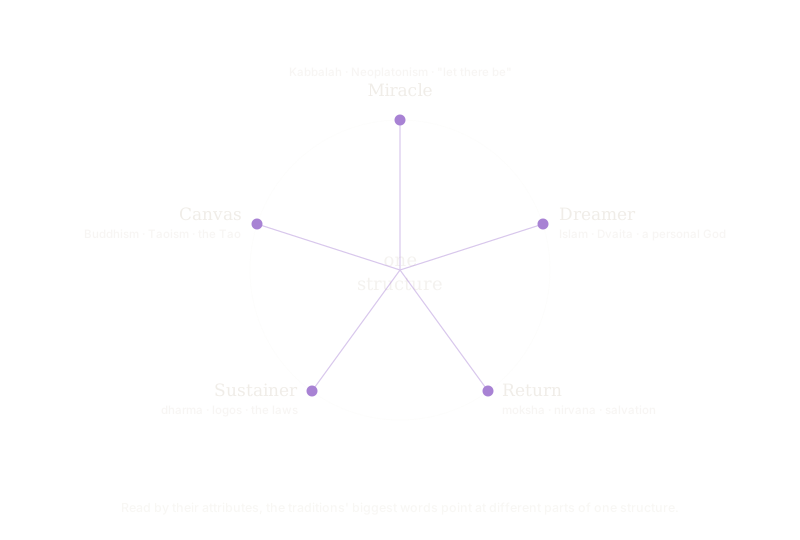
Now watch a famous contradiction dissolve. A personal creator God and a non-theistic ultimate with no creator at all look like a flat contradiction, monotheism against Buddhism, until you notice that one is describing the dreamer and the other is describing the canvas. They are not answering the same question. They are no more in conflict than "water is H2O" conflicts with "water is wet." Most of the great contradictions between traditions, read this way, turn out to be category errors: two true answers about two different aspects, forced into a fight because we assumed a single target.
The traditions already do this
The deepest traditions already carve these joints themselves, on their own. That is the strongest sign the aspects are real: the sharpest voices inside each tradition found them first, working alone. Advaita Vedanta distinguishes nirguna Brahman, the attributeless absolute, from saguna Brahman, the same reality with attributes as a personal God, and says plainly that these are two standpoints on one thing, the distinction arising from the observer rather than from a division in Brahman. Buddhism has its two truths, the conventional and the ultimate. Christian theology has its apophatic way, which speaks of God only by negation, alongside its cataphatic way, which speaks in attributes. Eckhart put the Godhead beyond even God. None of these thinkers took the impersonal ground and the personal creator to be a contradiction. They took them to be aspects. The model here just does across the traditions what the sharpest voices inside each already did within their own.
The discipline that keeps it honest
An idea that can dissolve any contradiction on demand explains everything and therefore predicts nothing, so this one has to be constrained or it is worthless. Three constraints keep it honest.
First, attributes decide. A term is assigned to an aspect by what the text says it is like, not by what is convenient. Where the attributes fit no aspect cleanly, that is marked as an open cell, not forced into one. The willingness to say "this does not sort" is what makes the model falsifiable rather than a universal solvent.
Second, readings are options, not facts. Scripture reaches us through centuries and languages, worn by translation, so a word may not carry the sense it began with. Every reading is therefore held as a candidate at a probability, offered as "this could be pointing at the canvas, or at the miracle, and here is why," never asserted as the settled meaning.
Third, nothing is claimed past what can be known. The one certainty is that experiencing is occurring. Everything downstream of that, every aspect, every mapping, every weight, is a calibrated bet carried with a defeater, in exactly the way the rest of this site holds its claims. The model is a map of possibilities with honest weights on them, not a verdict about which tradition is true.
The claim, kept small
The claim is small. The traditions are partial maps of one structure, and the model says which part each one draws. It leaves the genuine disagreements standing and marked, because some differences are real clashes and not a matter of aspect. And it proves no religion true. A creator, a founding miracle, a hand steering history are the aspects furthest past proof, so they rest on faith either way. Two things it is not: a merger, and the claim that all religions say the same thing, which is lazy and false. What you get is a map of who drew which part, honest about where they meet, where they clash, and where nobody knows.
Where this goes
Each of the hard questions underneath this gets its own page: the origin, whether there was a beginning at all or only ever an eternal ground; the nature of that ground, still or in motion, aware or not; whether there is one ground or many; and what holds the laws in place. Alongside them, a comparison of the major traditions, aspect by aspect and with sources; an honest accounting of where they genuinely disagree; and a map of what can and cannot be known about any of it. This post is the frame. The rest is the work.
Part of The Unification Map, the same move pointed at the biggest words we have, and resting on Starting From "I Am". The rigorous version, with the aspects tagged and sourced, is in the Library: The Open Questions and The Aspect Model.
Questions
- Does this claim all religions are the same?
- No, and that claim is false. The model says the opposite of a merge: the traditions often point at different parts of one structure, so what looks like a contradiction is usually two answers to two different questions. It maps where they genuinely converge and where they truly differ, and it holds every reading as an option at a probability, never as a settled fact.
- How can contradictory religions all be right at once?
- By not being answers to the same question. If one tradition describes an impersonal, attributeless ground and another describes a personal creator with intent, those are not rival answers; they are descriptions of different aspects, the canvas and the dreamer. Read by their attributes, many apparent contradictions turn out to be category errors, like arguing whether water is H2O or wet.
- Isn't this just perennialism, the idea that all religions share one truth?
- It is stricter than that. Naive perennialism flattens real differences by declaring a single shared core. This model keeps a falsifiability constraint: each term is assigned to an aspect by its attributes, and where the attributes fit no aspect cleanly, that is marked as an open cell rather than forced. It is a map with seams, not a blur.
Keep reading
Get new writing by email