
Frameworks · July 2026
What Each Tradition Actually Says
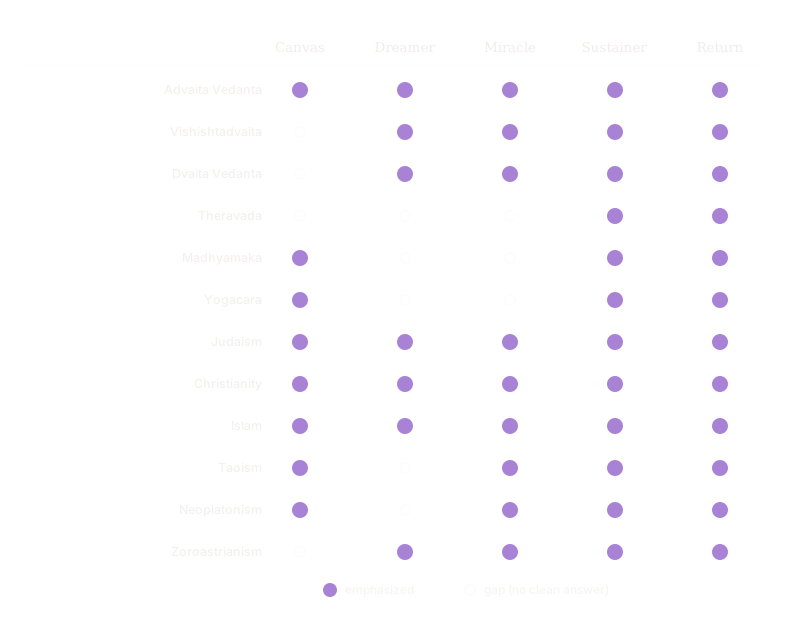
Lay eight major traditions side by side, sorted by which aspect of one structure each is describing, and a pattern appears. They are not eight rival theories of the same thing. They are eight uneven maps, each detailed where it looked hardest and blank where it did not look at all, and the blanks are as telling as the entries.
The aspect model makes a testable claim: each tradition describes a different part of one structure. To test it, lay them out and see whether the attributes actually sort, or whether "different aspect" is a trick loose enough to fit anything. Laid out, they sort, unevenly and honestly.
A few contrasts
Islam puts almost all its weight on the dreamer and the miracle. One God, Allah, and creation by a single word: "Kun fayakun," Be and it is. It is dreamer-first, and it holds the ground itself, the Dhat, the divine Essence, to be beyond human reach.
Buddhism does close to the opposite. It has no creator and no beginning at all. The world is empty, sunyata, and arises by dependent origination, conditioned, with no first event. Ask a Buddhist who made it and the honest answer is nobody, and it did not begin. That is not an evasion, it is the position, and it fills the canvas and the return while leaving the dreamer and the miracle deliberately blank.
Taoism sits between them: a ground, the unnameable Tao, that gives birth to the world, but impersonally. "The Tao gives birth to the one, the one to the two, the two to the three, the three to the ten thousand things." That is creation with no creator.
And Advaita Vedanta all but states the model outright. It names the attributeless absolute, nirguna Brahman, and the personal God, Ishvara, as two standpoints on one reality, the difference coming from the observer and not from a split in the thing. The canvas and the dreamer, distinguished from inside the tradition.
The disagreement runs inside a tradition too
The sharpest evidence is not between religions but within one. Vedanta is a single tradition built on a single set of scriptures, and its schools still disagree, and they disagree about exactly this. Advaita puts the impersonal ground first and treats the personal God as a lower, provisional truth. Ramanuja's Vishishtadvaita makes the personal God ultimate and the world his living body. Madhva's Dvaita goes all the way to a fully personal God, eternally separate from every soul, with no impersonal ground behind him at all. Same texts, same lineage, and the schools line up along the axis from canvas to dreamer like beads on a wire. Buddhism does the same on the question of the ground: Theravada allows no absolute at all, Madhyamaka names it emptiness, Yogacara comes close to calling it mind. The model's central claim turns out to be visible not only between the great religions but inside a single one, which is the last place a merely imposed scheme would hold.
Eight uneven maps
The pattern that comes out is not eight rival theories of one thing. It is eight uneven maps. Each is drawn in detail where that tradition looked hardest, and left blank where it did not look. Islam and Zoroastrianism render the dreamer in high resolution. Buddhism and Taoism render the canvas. The Kabbalists and the Neoplatonists render the miracle, the step from one to many, in loving detail. Put the maps on the same grid and they do not so much contradict each other as fill in each other's gaps, with real disagreements still showing where they remain.
And the gaps matter as much as the entries. Buddhism's missing dreamer is a claim, not an oversight. Zoroastrianism's missing canvas is honest, so the table leaves it open rather than inventing a ground the texts do not assert. A model that forced every tradition to fill every cell would be lying. This one lets the blanks stand, and the blanks are where it tells the truth about the differences.
What it is and is not
It is not proof that any tradition is right. It is not a merger, and it is emphatically not the claim that they all say the same thing. It is a map of who mapped what, held as readings rather than rulings, and it is the most concrete form of the whole idea: that under the many vocabularies there is one structure, and each tradition has been drawing the part of it that it stood closest to.
Part of The Open Questions. The full grid, with the terms, the honest gaps, and sources for every tradition, is in the Library: The Traditions by Aspect.
Questions
- Do all religions describe the same God?
- Not quite, and that is the point. Laid out by aspect, the traditions describe different parts of one structure: some map an impersonal ground (the canvas), some a personal creator (the dreamer), some the origin event, some the sustaining order, some the return. They overlap and they leave different blanks. It is closer to eight partial maps of one terrain than eight rival portraits of one figure.
- Which religion has no creator God?
- Buddhism, in its main philosophical form, has no creator and no first event. The world is held to be empty (sunyata) and to arise by dependent origination, conditioned and beginningless. Taoism and Neoplatonism also lack a personal creator: in them the world comes from the ground by impersonal generation or necessary overflow, not by a mind's choice.
- Is this saying all religions are the same?
- No. It is a map of who mapped what, held as readings and not rulings. The traditions genuinely differ, and some of the differences are real disagreements, not just different aspects. What the comparison shows is that much of the apparent conflict comes from each tradition making a different aspect central, and that the blanks in each are meaningful, not oversights.
Keep reading
Get new writing by email