
Library document
The Traditions by Aspect
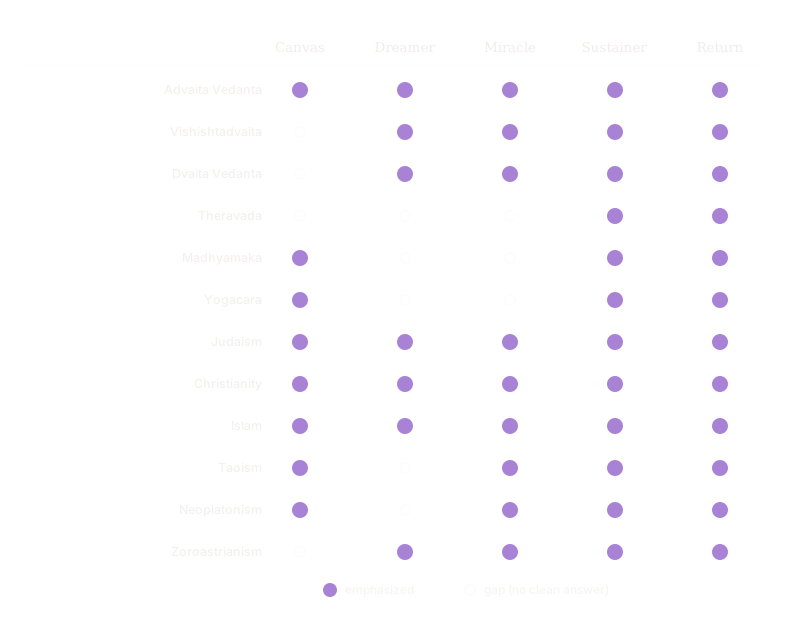
The comparative matrix: the major traditions, split by school where the schools disagree, read across the five aspects (canvas, dreamer, miracle, sustainer, return). The at-a-glance table, what the intra-tradition splits show, the honest gaps, per-tradition notes, and verse-level sources. Held as readings, not settled fact.
The post What Each Tradition Actually Says is the readable version. This is the matrix itself, read across the five aspects of the aspect model. Where the schools of a tradition genuinely disagree, they get their own rows, because that disagreement is itself informative. Every cell is a reading held under the discipline (attributes decide; scripture is a lossy source; nothing asserted past the one certainty), not a settled fact. Where a tradition has no clean answer for an aspect, that is marked, not forced. The framing is FRAMING; the specific terms are ESTABLISHED as belonging to each school.
The matrix
| Tradition (school) | Canvas (impersonal ground) | Dreamer (creator mind) | Miracle (origin) | Sustainer (order, law) | Return |
|---|---|---|---|---|---|
| Advaita Vedanta (Shankara) | nirguna Brahman | saguna Brahman, Ishvara (provisional, via maya) | srishti, apparent through maya | Ishvara; dharma | moksha: Atman is Brahman ("tat tvam asi") |
| Vishishtadvaita (Ramanuja) | none above God | Brahman as the personal Vishnu; souls and world are God's real body | real creation by God | God as the inner controller | loving union with God, not identity |
| Dvaita Vedanta (Madhva) | none | Vishnu, fully personal, eternally distinct from souls | real creation | Vishnu sustains a dependent world | liberation by grace; the distinction persists |
| Theravada Buddhism | none: no absolute, only process | none: "no Maker" (anatta) | none: beginningless | karma; dependent origination | nibbana: cessation of self |
| Madhyamaka Buddhism | sunyata; Dharmakaya | none | none: beginningless | dependent origination | nirvana |
| Yogacara Buddhism | consciousness-only (cittamatra); the storehouse consciousness | none | none: beginningless | the storehouse consciousness (alaya-vijnana) | transformation of consciousness |
| Judaism (with Kabbalah) | Ein Sof | YHWH, personal creator | ex nihilo (Genesis 1); tzimtzum | providence; Torah | tikkun olam; the world to come |
| Christianity | the Godhead (Eckhart) | God the Father, the Trinity | ex nihilo; the Logos (John 1) | providence; the Logos | salvation; theosis (Eastern Orthodox) |
| Islam (with Sufism) | the Dhat; al-Haqq, the Real | Allah, al-Khaliq (tawhid) | "Kun fayakun" (Be, and it is) | al-Qayyum, the self-sustaining | return to Allah; fana and baqa |
| Taoism | the Tao (unnameable) | none (impersonal) | the Tao gives birth to one, two, three, the ten thousand (TTC 42) | wu wei; ziran | return to the Tao |
| Neoplatonism | the One | none (necessary overflow) | proodos (emanation) | the hypostases; the World Soul | epistrophe; henosis |
| Zoroastrianism | none (Zurvan only in the heterodox variant) | Ahura Mazda (with Angra Mainyu) | Ahura Mazda's creation; the cosmic conflict begins | asha (truth, order) against druj | frashokereti, the renovation |
What the splits show
The rows that share a tradition are the sharpest evidence for the whole model, because they show that even the disagreements inside a tradition are disagreements about which aspect to make central.
- Vedanta runs the full canvas-to-dreamer axis. Advaita puts the impersonal ground (nirguna Brahman) first and treats the personal God as a provisional appearance. Vishishtadvaita makes the personal God ultimate and the world his real body. Dvaita goes all the way to a fully personal God eternally distinct from everything else, with no impersonal ground at all. Same scriptures, same Vedanta; the schools differ by where on the canvas-dreamer axis they plant the ultimate.
- Buddhism runs the full ground axis. Theravada is the most austere, no creator and arguably no positive absolute, only conditioned process. Madhyamaka names the ground as emptiness. Yogacara comes closest to an idealism, making consciousness the substrate. The disagreement is precisely about what, if anything, the canvas is.
That intra-tradition variation is the model's central claim, visible inside a single lineage.
What the gaps show
The empty cells are the model working, not failing. The discipline says assign by attributes, and where nothing fits, leave it open.
- Every Buddhist school lacks a dreamer and a miracle. All are non-theistic and hold the world beginningless (dependent origination refutes both a creator god and a first event). They differ on the canvas and agree on the absences.
- Taoism and Neoplatonism have no personal dreamer. In both, the world comes from the ground by impersonal generation or necessary overflow, not by a mind's choice.
- Zoroastrianism and Dvaita have no clean canvas. Both make a fully personal God ultimate, with no impersonal ground behind him (only the heterodox Zurvanite variant posits Zurvan, infinite Time, as prior). Their canvas cells are honestly left open.
Per-tradition notes
- Vedanta. Advaita's own statement of the aspect model is explicit: nirguna and saguna Brahman are two standpoints on one reality, differing by the observer. Vishishtadvaita and Dvaita reject that the personal God is merely provisional, and in doing so simply relocate the ultimate toward the dreamer end of the axis.
- Buddhism. Emptiness (Madhyamaka), consciousness-only (Yogacara), or bare conditioned process (Theravada) for the ground; no creator in any; the order is karma and dependent origination, not a lawgiver.
- Judaism. Ein Sof for the canvas; a personal creator; two origin stories layered, the ex nihilo of Genesis and the tzimtzum of Lurianic Kabbalah, where the infinite contracts to make room.
- Christianity. The apophatic Godhead behind the personal God (sharpest in Eckhart); creation through the Logos, "through whom all things were made"; and, in the Eastern church, a return of theosis, union with God's energies while keeping one's own identity.
- Islam. Tawhid, the absolute oneness of the Dhat; creation by the command "Kun fayakun"; Allah as al-Qayyum, sustaining all things moment to moment; and, in Sufism, the return as fana and baqa. Ibn Arabi's wahdat al-wujud reads al-Haqq, the Real, as the one reality.
- Taoism. The unnameable Tao; no personal creator; impersonal generation (one, two, three, the ten thousand things); a sustaining by non-interference, wu wei and ziran.
- Neoplatonism. The One beyond being; creation as proodos, an eternal necessary overflow, not a choice; the soul's return as epistrophe and henosis.
- Zoroastrianism. Dreamer-first: Ahura Mazda against Angra Mainyu; the order held by asha against druj; and one of the most developed returns of any tradition, frashokereti, the final renovation when evil is undone and the world made whole.
Sources
Primary texts are cited as pointers, held under the translation caveat (a reading, not a fixed meaning), with the school and term ESTABLISHED as belonging to the tradition.
- Vedanta: Chandogya Upanishad 6.8.7 ("tat tvam asi") and the Mandukya Upanishad (Om as Brahman and atman) for Advaita; Ramanuja's Sri Bhasya (Vishishtadvaita); Madhva's panchabheda, the fivefold difference (Dvaita). ESTABLISHED
- Buddhism: the anatta and dependent-origination suttas (Theravada); Nagarjuna's Mulamadhyamakakarika (Madhyamaka); Asanga and Vasubandhu, cittamatra and the alaya-vijnana (Yogacara). ESTABLISHED
- Judaism: Genesis 1 (creation by speech); Ein Sof and tzimtzum in Lurianic Kabbalah; tikkun olam. ESTABLISHED
- Christianity: Genesis 1 and John 1:1-3 (the Logos through whom all was made); Meister Eckhart (the Godhead); theosis (Eastern Orthodox). ESTABLISHED
- Islam: Qur'an 112 (al-Ikhlas, absolute oneness) and 2:117 ("Kun fayakun"); al-Qayyum among the divine names (al-Ghazali); fana and baqa, and wahdat al-wujud (Ibn Arabi), in Sufism. ESTABLISHED
- Taoism: Tao Te Ching (Laozi), chapters 1 and 42; wu wei and ziran. ESTABLISHED
- Neoplatonism: Plotinus, Enneads; proodos and epistrophe; henosis. ESTABLISHED
- Zoroastrianism: the Gathas and later texts; Ahura Mazda and Angra Mainyu; asha; frashokereti; Zurvan (heterodox Zurvanite). ESTABLISHED
Every cell is a reading, not a ruling. The table now splits the schools that genuinely disagree, but it still simplifies: mystical and mainstream strands differ within each of the remaining rows too, and a yet fuller version would keep dividing. What it shows is the shape, that the traditions and their schools distribute their attention across the same handful of aspects, and that their conflicts are largely differences in which aspect they made central. Where those conflicts are genuine rather than category errors is set out in Genuine Disagreements.