
Frameworks · June 2026
The Unification Map: One Frequency, Many Adapters
Everything is more connected than our words for it suggest. What feels like separate worlds (electricity, heat, radio, light, sound) is one continuous thing wearing different vocabularies, and most of the walls between them are terminology, not nature. This is a map of the one thing, the translators we build to cross it, and the gaps where a translator is still missing.
We are taught the world in pieces. Electricity is one subject, heat another, light another, sound another, radio another still. Different classes, different instruments, different units, different experts. By the time you are grown the pieces feel like separate worlds.
They are not separate. They are one continuous thing, and the only reason they feel separate is that we built a different vocabulary for each piece and then mistook the vocabularies for the world.
That is the whole idea, and it is bigger than physics: there is a cohesiveness to everything, and most of what looks like a boundary is just two different words for the same thing. Different people, different fields, and different machines keep naming one thing in many ways, and the names harden into walls that were never really there. Pull the walls down and what is left is connected, all of it.
It is vibration, interplaying with vibration
Start at the bottom. A wave needs something to move through, and we call that something the medium, or the substrate, and we treat it as a passive stage the wave crosses. As far as we can probe, the stage is neither passive nor separate: the medium is itself vibration, and a wave moving "through" it is one vibration meeting another and interplaying with it. As far down as we can currently reach, we never find a still, solid floor, only more vibration. Matter is made of it, and so is the vacuum, which is not empty but a seething field. Whether something still underlies what we can probe, we cannot say, and this framework does not claim to. As far as we can see, it is vibration, folding back on itself.
So even the line between "the wave" and "the thing it travels through" is one more wall made of words. As far as we can reach, there is one kind of thing, vibration, and everything else is how much, how fast, and how it interplays with the rest.
Adapters are translators
If the boundaries are made of vocabulary, then the most important tool humanity builds is the translator: the device that takes one form of the one thing and converts it into another form we can receive. Call it an adapter.
Your eye is an adapter. It takes a sliver of vibration and turns it into sight. A thermal camera is an adapter. It takes the vibration we call heat and turns it into the vibration we call color, which your eye already reads. A radio is an adapter. It takes the vibration we call a broadcast and turns it into the vibration we call sound.
Here is the part that matters. A working adapter is a proof. The moment you can build a device that faithfully turns A into B, you have shown that A and B were never truly separate. They were the same thing in two vocabularies, and the adapter is the dictionary between them. Every transducer ever built is a small proof of the cohesiveness, a place where a wall turned out to be a door.
Exhibit A: the spectrum
The cleanest proof is the frequency spectrum. Lay electricity, radio, heat, light, and sound on a single axis of frequency and the separate worlds line up as one continuum. They were five vocabularies for vibration at different rates.
Be precise about what unites them, because the axis alone does not. A sound at a given frequency and a radio wave at the same frequency are not the same object; they are vibration in different company. What actually makes them one family is a single law that holds across all of them: a quantum of any of them carries energy in proportion to its frequency, by the very same constant. That law, not the chart, is the kinship. The axis only lines them up; the law makes them relatives.
And the adapters prove it. We convert across this spectrum constantly: light to electricity in a solar cell, sound to radio in a phone, heat to an image in a camera. Every one of those conversions quietly shows that the two sides were never really apart.
The same wall, in machines
None of this is only about physics. The deepest version of the idea is that the fragmentation is general: people and machines split everything the same way, by giving one thing many names.
Watch it happen in software. One company calls a person a "user," another a "customer," another a "member," another an "account," and their systems cannot talk to each other, not because the thing is different but because the words are. Every integration, every data migration, every API wired to another API is the same act as building a thermal camera: an adapter between two vocabularies for one underlying thing. The fragmentation of the spectrum and the fragmentation of a database are the same problem wearing different clothes.
This is where it gets pointed, and where the opportunity sits. Machines are, right now, the worst offenders. Every system ships its own dialect and the walls multiply. But a machine that could reliably recognize when two different terms mean the same thing would be the universal adapter, the translator for everything. That is the prize. It is also, for the moment, the thing machines are worst at, because they learn our fragmented vocabularies and faithfully reproduce every wall we ever built.
The map, and where it is empty
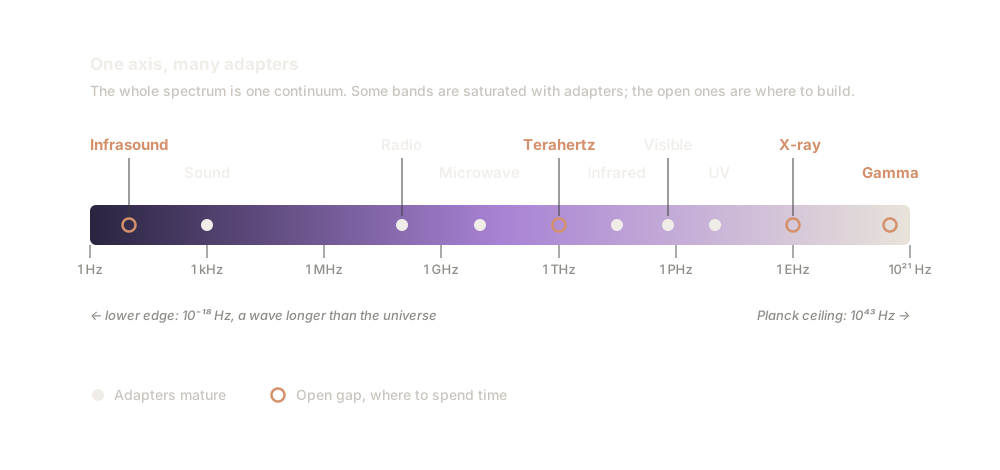
So here is the work. Catalog the adapters, every translator we have built, across physics and beyond it, and lay them out. The crowded regions are where we already cross freely. The empty regions are the entire point: a missing adapter is a synonym we suspect but have not yet proven. Two things we think are one, with no dictionary built yet to show it.
Those gaps are the to-do list. Some are near and buildable: cheap sensors that turn invisible bands into something we can see, wearable translators, the handheld tools that would let anyone read what is currently lab-only. Some are far and hard, where the interplay is so weak that we can detect a thing but cannot yet convert into it. Marking the hard edges honestly matters as much as marking the easy wins, so effort flows to where a door can actually be opened.
Why this is the work
Find the walls that are only words. Build the translator that proves it. Hand the result to a human sense, or to a machine that serves one.
That is the shape of progress, stated plainly: the patient demolition of false boundaries, one adapter at a time. I keep returning to it because it is the same move I trust everywhere else. When something looks like many separate problems, I go looking for the one thing underneath and the words that hid it. This is that move, pointed at everything.
The pieces of the map
This post is the whole at altitude. Each part of it opens into its own deeper piece:
- From waves to things: the map does not stop at light and sound. Matter, and even a living body, are the same one thing folded further, with no new substance added at any step.
- There is no line called alive: the living and non-living split dissolves once you see that "alive" is a bundle of separate, graded properties, not a single thing with a boundary.
- The inside of the one thing: the one place the map reaches past what can be known. Awareness and will, the panpsychist lean and its honest defeaters, held as calibrated ideas rather than answers.
- How the religions could all be right: the same synonymy move at the highest stakes, sorting the traditions' biggest words into different aspects of one structure so they need not contradict.
- Adapters as translators: what an adapter actually is, and why a working one is a proof that two named things were one thing all along.
- Where adapters fall short: the distinct ways a translator fails, and the small mystery that exposes them. Why did we build a machine to see heat instead of one to hear it?
Underneath all of it is the floor the whole thing stands on: Starting From "I Am", on why this is held at high confidence rather than certainty.
The rigorous backing lives in the Library: the adapter inventory with the open gaps, the principles, the sources, and the lineage. Every claim there is tagged for what it is, settled or open.
Questions
- What is the Unification Map?
- The Unification Map is the idea that reality is one cohesive thing, and most of what looks like a boundary between separate domains, such as electricity, heat, radio, light, sound, or even data, is just two different words for the same underlying thing. We cross those false boundaries by building adapters, devices that translate one form into another, and a working adapter is evidence the two were the same thing all along.
- What is an adapter in the Unification Map?
- An adapter is a transducer, a device or organ that converts one form of the one thing into another form a sense or a machine can receive. An eye, a thermal camera, and a radio are all adapters. A working adapter is treated as a proof that the two forms were the same thing in different vocabularies.
- Is everything really vibration?
- It is held as a high-confidence bet, not a certainty. The simplest account of everything examined is that it is vibration interplaying with vibration, with even the medium itself being vibration. The claim is tagged as framing, and its defeater is stated plainly: a demonstrated phenomenon that resists every vibration or field description would lower it.
Keep reading
Get new writing by email