
Explorations · September 1, 2026
What Holds It Together? Explored to Its Corners
Does something hold reality together and enforce its laws, or does nothing need to?
The question
Reality is not chaos. It holds together and runs on laws, the same ones, everywhere we look. So does something hold it together and force the rules, or does nothing need to? The shorter treatment lives in What Holds It Together? and the Library. One piece is close to free before the corners start: whatever exists at least does not contradict itself, and that floor enforces itself, since a contradiction describes nothing. The real fight is over everything past consistency: why these laws, this constant, this persistence.
Corner A at full strength: nothing holds it
Hume's answer, and it is cleaner than it first sounds. The laws are just the patterns that happen to hold. There is no glue under them, no enforcement, no engine room. Talk of laws "governing" the world is a metaphor borrowed from courtrooms, and nothing in any experiment has ever shown the governing, only the regularity. Every alternative posits invisible machinery; this corner simply declines to. It is the most economical position on the board, and economy has a strong track record.
Corner B at full strength: something governs it
The regularity is too perfect to shrug at. Every electron everywhere obeys the same rules to the last decimal, forever, and "it just does" starts to sound less like economy and more like refusal. So this corner posits real governance: relations of necessity between properties that make the regularities hold, in the philosophers' version; mathematical necessity, in Tegmark's version, where the laws hold because reality is a structure and the laws are its theorems; or, in the oldest version, a sustaining mind that holds every regularity in place from moment to moment. That last form is where the traditions' sustainer lives, dharma and the Logos and the cosmic dance, and where belief re-enters, because a sustaining intent sits past all proof.
Could both be true?
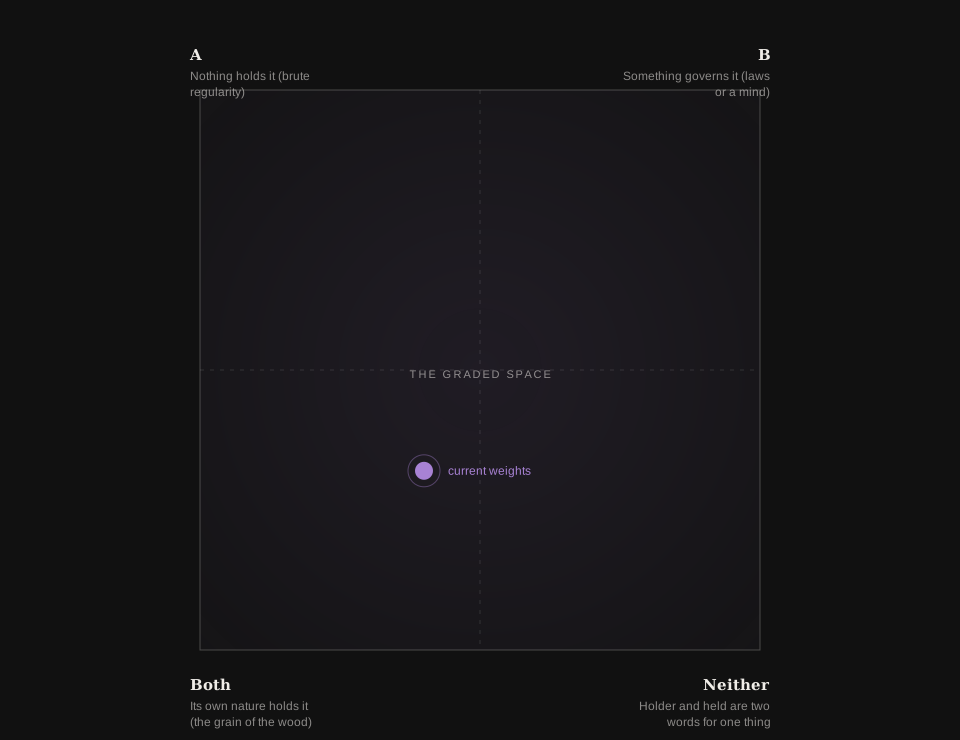
Yes, and this is where the weights sit. Dispositionalism says things have natures: powers, tendencies, ways of behaving that are simply what the things are. The laws are not rules imposed from outside (corner B's picture) and not free-floating patterns (corner A's picture); they are descriptions of what the one thing must do, given what it is. The grain of the wood, not commandments nailed onto it. This keeps corner A's economy, since nothing external is added, and keeps corner B's necessity, since the regularities really are held, by the nature of the thing itself. For a framework built on one thing with one nature, it is the obvious fit.
Could neither be true?
Yes, by the site's own signature move. "What holds it together" pictures two items: the held thing and the holding. But a thing and its way of behaving may be two words for one reality, the way a dance and its dancing are not two things needing a strap between them. If so, the question misfires the way "what is north of the north pole" misfires: not because the answer is mysterious, but because the grammar invented a gap and then asked what fills it. On this reading, corner A was right that there is no glue, and corner B was right that nothing is loose, and both were wrong to accept the picture of a holder and a held.
The graded space
Corner A holds the discipline: never posit machinery no test has shown. Corner B holds the datum: the regularity is real, total, and unexplained by shrugs. The both corner holds the synthesis with a nature instead of a nail. The neither corner holds the warning that even "nature" may be one more word laid over the seamless fact. What stays genuinely open past all of this: why these laws rather than others, and whether the world's continuing in being needs anything at all, which is the doorway through which a director, and belief, return.
If A, then. If B, then.
If nothing holds it, then the regularity is the deepest brute fact there is, and gratitude is a more honest response than explanation.
If something governs it, then the next question is whether the governor has anything like intent, and that question sits past evidence: the sustainer aspect becomes a matter of faith, exactly where the traditions put it.
If its own nature holds it, then physics is the study of one thing's character, and the laws are biography, not legislation.
If holder and held are one, then the question retires with honors: the world does not need holding together because it was never in pieces, which is the one-thing thesis said backwards.
Weights
| Claim | Weight | Defeater |
|---|---|---|
| The world hangs together by being consistent | Very high | A demonstrated true contradiction in reality |
| The laws are the dispositional nature of the one thing | Best fit, leaned toward | Laws shown to float free of any natures |
| The laws are brute, or externally governed, or theorems | Each live | Decisive evidence for one over the others |
| Moment-to-moment sustaining is needed | Open | A demonstration the ground is necessary (then it is free) or contingent (then it is owed) |
The line
Evidence reaches the regularity and its candidate explanations. Whether anything intends the holding, whether the sustainer is a someone, sits past every possible test. That is the line, and belief lives on the far side of it, as it always has.
Questions
- What makes the laws of physics hold?
- Nobody has ever observed the enforcement, only the regularity. The candidates are: nothing holds them (Hume's brute patterns), something governs them (necessity relations, mathematical structure, or a sustaining mind), or the laws are simply the nature of the thing itself. This page weighs the last option highest: the grain of the wood, not commandments nailed onto it.
- What did Hume say about the laws of nature?
- That the laws are just the patterns that happen to hold. There is no glue under them and no engine room. Talk of laws governing the world is a courtroom metaphor, and no experiment has ever shown the governing, only the regularity. It remains the most economical position available.
- What is dispositionalism?
- The view that things have natures: powers and tendencies that are simply what the things are. On this reading the laws are not imposed from outside and not free-floating patterns; they are descriptions of what the one thing must do, given what it is. It keeps Hume's economy while explaining why the regularities really hold.
- Does the universe need something to sustain it from moment to moment?
- Open, and this page keeps it open honestly. If the ground exists by its own nature, continuing in being costs nothing and needs no sustainer. If it is contingent, something owes it. Whether any sustaining is intended is past every possible test, which is exactly where the traditions place faith.
Get new writing by email