
Explorations · August 28, 2026
The Ground, Explored to Its Corners
If there is a ground under everything, is it aware or blind? And is that even the right question?
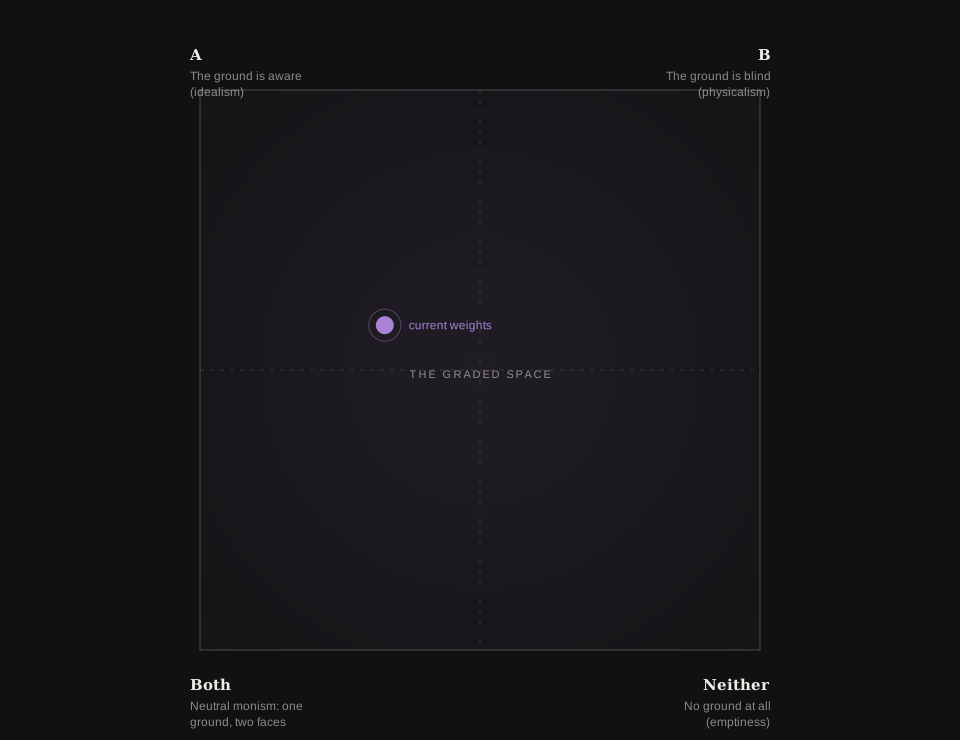
The question
Under everything we can see and measure, there may be something that it all rests on. Call it the ground. I want to know what it is like: is it aware, or is it blind? The question usually shows up as an either-or between mind and matter, and part of the work here is deciding whether that either-or deserves to survive. The shorter treatment of this question lives in What the Ground Is and the Library, and this page goes all the way down each corner of it.
Corner A at full strength: the ground is aware
Start with the one thing nobody can doubt: experience is happening right now. That certain thing is awareness, and it is the only feature of reality anyone has ever checked from the inside. A view that puts awareness at the bottom starts with a real advantage, because it never has to explain how experience comes from stuff that has none. That unsolved puzzle is called the hard problem, and it belongs entirely to the other corner.
This view has been worked out carefully by serious people. Berkeley made the classic case that the physical world is how mind appears, rather than a second kind of stuff. Kastrup's modern version says reality is one big mind, and each of us is a part that split off from it, similar to the way one person can split into several identities. That comparison matters, because it gives the view a real example of how one awareness could show up as many. There is also the evidence from meditation. People who go deep into it keep reporting the same still awareness under the noise of the mind, across cultures that never met. That evidence comes from the inside and it could be wrong, but it is not nothing.
Corner B at full strength: the ground is blind
This corner deserves just as strong a case, because it is the majority view among people who study minds for a living, and it has the best track record in history behind it. Every mind ever found came with a brain, and when the brain is damaged, the mind changes in ways doctors can predict. Awareness shows up late in the universe, and only where nervous systems evolved. Science has explained more of the world than every other approach combined while assuming a blind ground, and it has never once needed awareness in an equation. The simplest story is one kind of stuff running on blind rules, with experience as something that certain arrangements of it do.
This corner agrees that the hard problem is real, but it points out that unsolved is not the same as unsolvable. Science has buried many mysteries that once felt this deep. The old idea of a special "spark of life" felt exactly this way, right up until biology explained living things without it.
Could both be true?
Yes, and the answer is a classic position rather than a compromise invented here. Neutral monism, developed by Russell and James, says the ground is neither mind nor matter but something more basic that shows both faces. Physics tells us how things behave, but it stays silent on what anything is from the inside, and awareness is the one place where we catch the inside directly. On this reading, "aware or blind" is a trick of vocabulary, two half-descriptions of one thing. That is exactly the shape this site expects a false either-or to have. The both corner is not the weak middle here. It may be the simplest answer on the board, and it has been underrated for a century.
Could neither be true?
Yes, and this corner is older than the other three. The sharpest school of Buddhist philosophy, Madhyamaka, says there is no ground at all. Things lean on each other, with each one caused by others, and there is no floor under the whole. The question "what is the ground like" assumes there is one, and this corner simply declines that assumption. No experiment can ever rule it out, because every experiment looks at what is happening and never underneath it.
The graded space
Each corner holds a piece that the others need. The blind corner holds the track record: whatever the ground is, the world runs on rules, and science reads them well. The aware corner holds the certainty, since awareness is the one thing that cannot be subtracted from the picture. The both corner holds the warning about vocabulary, and the neither corner holds the warning about assuming a floor in the first place. My honest position lives in this middle space. It leans toward the aware corner, and it moves when the arguments move.
If A, then. If B, then.
If the ground is aware, then awareness does not get born and does not die. A person is a local pattern in something that was always awake, so death becomes a question about the pattern rather than about awareness itself. Meditation becomes a way of looking rather than just a mood, and care for others widens, because insides are no longer rare.
If the ground is blind, then awareness is local, made, and mortal, which makes it the rarest thing we know of rather than the most common. Meaning is not found but made, and the window for making it is one life wide. I don't read that as bleak. I read it as a reason to focus.
If both are true, then the war between mind and matter ends as a translation mistake, and the interesting work moves to the dictionary between the two vocabularies, which is where this site already stands.
If neither is true, then there was never a floor to find, and the searching itself was the problem. That is Buddhism's actual claim about how suffering ends, and it deserves to be taken seriously rather than treated as exotic.
Weights
| Claim | Weight | Defeater |
|---|---|---|
| The ground is aware | Leaned toward | A convincing account of awareness coming from stuff that has none, or a reason the certainty stops short of the ground |
| The ground is blind | Live rival, the majority view | Solving the hard problem in its favor would close the question |
| One neutral ground, two faces | The strongest reconciliation, long underrated | A demonstration that behavior is all there is |
| No ground at all | Low, live, and beyond the reach of any experiment | A demonstration that something must hold the happening up |
The line
Evidence carries this question as far as the table above and no further. Whether an aware ground means anything by the world, whether there is intent behind it, sits past every test anyone could run. That is the line. On the near side of it, these are ideas held at weights. On the far side is belief, and I mark the line so I never mistake one side for the other.
Questions
- Is the ground of reality aware or blind?
- Nobody knows, and this page does not pretend to. It makes the strongest case for each answer and ends with weights: a lean toward an aware ground, because awareness is the one thing that cannot be subtracted from the picture, with the blind ground kept as a live rival because it carries science's entire track record.
- What is neutral monism?
- The view, worked out by Bertrand Russell and William James, that the ground is neither mind nor matter but something more basic that shows both faces. Physics tells us how things behave and stays silent on what anything is from the inside, so the mind-versus-matter fight may be two half-descriptions of one thing.
- What is the hard problem of consciousness?
- The unsolved puzzle of how experience could arise from stuff that has none. A view that puts awareness at the bottom never faces it. A view that puts blind matter at the bottom must solve it, and it points out in return that unsolved is not the same as unsolvable.
- Can any experiment settle whether the ground is aware?
- Not today, and possibly never. Experiments read behavior from the outside, and awareness is only ever caught from the inside. That is why this page ends by marking the exact point where evidence stops and belief begins, instead of claiming an answer.
Get new writing by email