
Explorations · August 31, 2026
One Ground, or Many? Explored to Its Corners
Is there one ground under everything, or many? And can the count ever be known?
The question
The one certain thing is a single experiencing, this one, now. It says nothing about whether the ground behind it is one or many. So the question is open, and it is the same question religion fights over as one god or many. The shorter treatment lives in One Ground, or Many? and the Library.
Corner A at full strength: one ground
Two arguments pull this way. The first is simplicity: one is simpler than many, and simplicity is a reason to prefer a view, though never on its own a reason to believe it. The second is sharper and older, the interaction argument. Suppose there were several grounds. If they interact at all, then whatever lets them interact is a deeper shared ground, and the real ground is that one, so the plurality collapses back to one. Schaffer's modern priority monism sharpens it: what is basic is the whole, and the parts derive from it, rather than the parts being basic and the whole assembled. Every relation we have ever found connects; nothing we know of is truly sealed off from the rest. That is exactly what a one-ground world would look like.
Corner B at full strength: many grounds
William James made the pluralist case honestly: the world we actually live in is messy, many, and loosely joined. The manyness is the datum. The single tidy Absolute is an abstraction laid on top of experience, not something anyone has ever met. "It is really one underneath" is an inference, held for reasons, and the pluralist points out that the reasons are a preference for tidiness, not evidence. If experience is the court of appeal, many wins by inspection.
Could both be true?
Yes, and this is the reconciliation the framework itself suggests. The manyness is real at the level of the world: things, minds, and places are genuinely distinct, and no honest monism denies it. The oneness is a claim about what is fundamental, not about what is real. Priority monism says exactly this: the whole comes first, the many derive from it, and both levels are fully real. In the religion vocabulary, polytheism read as many dreamers over one canvas makes the same move: many real powers, one shared ground. The corners stop fighting when "how many things are there" and "how many things are fundamental" are allowed to be different questions.
Could neither be true?
Yes, in a strange and specific way. Take the pluralist seriously and ask what "many grounds" would mean. If the grounds interact, the interaction argument collapses them to one. If they do not interact, they are sealed off from each other completely, and nothing on our side could ever register them: no observation, no effect, no trace. "How many grounds are there" would then be a question with no possible evidence bearing on it, ever. A count that nothing could ever confirm or deny is not a fact we can have; the question does not so much get answered as go dark.
The graded space
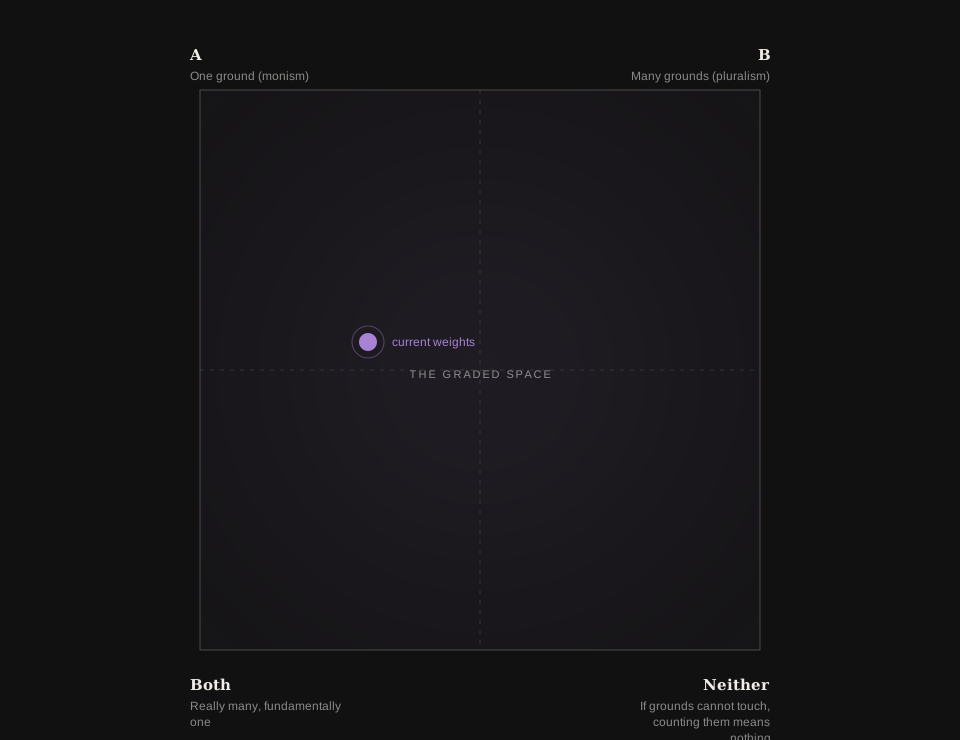
Corner A holds the logic: relation needs a shared ground, and everything we know relates. Corner B holds the phenomenon: the manyness is what experience actually delivers. The both corner holds the resolution that keeps each honest: really many, fundamentally one. The neither corner holds the epistemic warning: past a certain point, the count stops being knowable at all. The honest position leans toward one, keeps the manyness as fully real, and accepts that any sealed-off remainder is permanently beyond the reach of evidence.
If A, then. If B, then.
If there is one ground, then every boundary is ultimately internal: every separation between things, minds, and places is a feature within one thing, which is this site's whole thesis carried to the bottom. Monotheism and the mystics' one-ness claims sit naturally here.
If there are many grounds, then reality is a federation with no capital, and the search for a single deepest explanation has no finish line. Some questions would have several final answers, one per ground, and no arbiter.
If both, then nothing changes about daily life and everything changes about metaphysical bookkeeping: keep counting things at the world level, stop expecting the count to matter at the deepest level.
If neither can ever be settled beyond our own connected region, then humility is not a posture but a theorem: the map covers what can touch us, and claims about anything sealed off are exactly as empty as claims about nothing.
Weights
| Claim | Weight | Defeater |
|---|---|---|
| Reality is strictly one | Not proven | (it is the conclusion at issue) |
| Monism is the better bet | Leaned toward | A relation shown to need no shared ground |
| The manyness of the world is fully real | Firm | (denying it explains nothing and costs everything) |
| A sealed-off plurality could ever be detected | Doubted for good | A way to register what cannot interact, which is a contradiction in terms |
The line
Evidence and argument reach as far as the connected world. Whether anything lies beyond it, sealed off and uncounted, sits past every possible test, and I mark that line rather than pretend to see across it.
Questions
- Is reality one thing or many things?
- The answer weighed here is both, at different levels. The manyness of the world is fully real: things, minds, and places are genuinely distinct. The oneness is a claim about what is fundamental, with the many deriving from one shared ground. Keeping those as different questions is what lets both corners keep their best evidence.
- What is priority monism?
- Jonathan Schaffer's position that the whole is what is basic, and the parts derive from it, rather than the parts being basic and the whole assembled from them. It is the sharpest modern form of the one-ground view, and it does not deny that the parts are real.
- What is the interaction argument?
- Suppose there were several ultimate grounds. If they interact at all, whatever lets them interact is a deeper shared ground, and that one is the real ground, so the plurality collapses back to one. If they do not interact, nothing on our side could ever register them. Either way, counting past one never pays.
- Could there be separate realities sealed off from ours?
- If they cannot interact with our world, then no observation, effect, or trace could ever reach us from them, by definition. The question of how many there are would have no possible evidence bearing on it, ever. This page treats that not as an exciting possibility but as a question that goes dark.
Get new writing by email