
Explorations · August 30, 2026
Did It Begin? Explored to Its Corners
Did everything begin, or has something always been? And is that even one question?
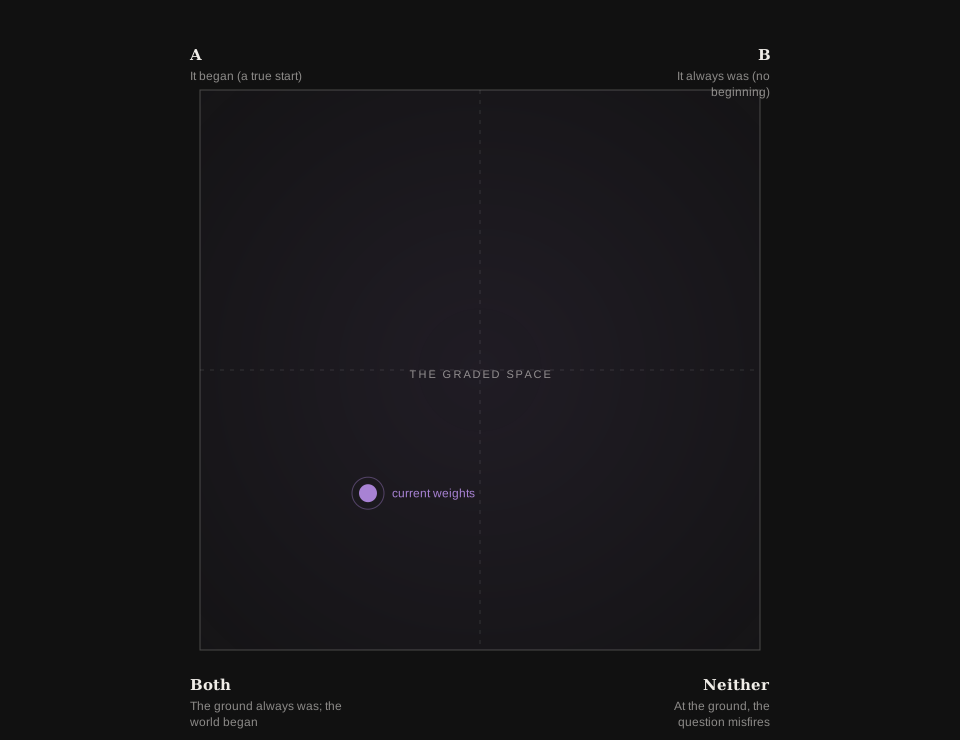
The question
Every creation story answers one question, and so does every physics of the early universe: did it begin, or has it always been? It arrives looking like a clean either-or, and the work of this page is to walk both sides at full strength and then ask whether the either-or itself deserves to survive. The shorter treatment lives in Did It Begin, or Has It Always Been? and the Library.
Corner A at full strength: it began
Two hard facts push this way. The first is order. If the universe were infinitely old, it should have run down to featureless heat long ago. Instead we sit in a strikingly ordered world, and Penrose put the improbability of that starting order at one part in ten to the ten to the hundred and twenty-three. That looks less like the middle of an eternity and more like a short time after a very special start. The second is a theorem. Borde, Guth, and Vilenkin showed in 2003 that any universe expanding on average cannot be stretched infinitely into the past; it must have a past boundary, and the result catches even the models built to escape it. Add al-Ghazali's thousand-year-old point that you can never finish crossing an infinite: if an infinite past had to pass before now, now would never have arrived.
Corner B at full strength: it always was
The oldest argument is four words: from nothing, nothing comes. If there were ever truly nothing, with no matter, space, time, law, or potential, there would be no engine for anything to arise from, and there would be nothing now. Something is here, so something must always have been. Parmenides said it; Spinoza built a system on a ground that exists by its own nature and cannot fail to be. And physics is friendlier to this corner than people assume: the Big Bang is the proven start of this expansion, not a proven start of existence. The Hartle and Hawking no-boundary model closes the early universe smoothly, with time curving into space so there is no first moment to point at, and cyclic models push any beginning back without end.
Could both be true?
Yes, and this is where the weights actually sit. The two corners stop fighting the moment you see they answer different questions. Whatever is necessary, the ground itself, does not begin, because a necessary thing cannot fail to be. So "it always was" is right, about the ground. This ordered, unfolding world that arises from or within that ground did begin. So "it began" is right, about the world. The traditions have held both at once for centuries without strain: the Ein Sof is eternal and the tzimtzum begins the world; Brahman is timeless and still pours out; the Tao is unnameable and gives birth to the ten thousand things. Both corners keep their best evidence, and the fight dissolves.
Could neither be true?
Yes, in a sharper way than it first sounds. If time is a feature of the world rather than a container the ground sits in, then "did it begin or has it always been" only means something inside the world. Asked of the ground, the question misfires, like asking what is north of the north pole. On this reading the famous either-or is not answered but dismissed: both "began" and "always was" are time-words, and the ground is not the kind of thing time-words reach.
The graded space
Corner A holds the physics of this world's boundary, and it holds up well. Corner B holds the logic of necessity, and it holds up well. The both corner inherits both and pays one honest price: the arising itself, the step from ground to world, becomes the one real mystery, and it may be undecidable for good, because every observation we could ever make sits inside the world, on the near side of that step. The neither corner is the both corner's deepest version, and it costs the most vocabulary. The honest position lives between both and neither, and nothing in it is asserted past its weight.
If A, then. If B, then.
If it truly began, from nothing at all, then the deepest question sharpens to its worst form: there was no engine, and yet here it is. Creation from nothing stops being a doctrine and becomes the only option standing.
If it always was, then nothing ever needed a first push, and the question moves from "what started it" to "why does it hold together at all." Eternity does not explain order; it makes the order stranger.
If both are true, then the mystery relocates. The ground needs no start and the world has one, and the single open question is the step between them. Whether that step was intended is where evidence ends and belief begins, and each person stands where they stand.
If neither, then the origin anxiety was a grammar mistake, and the honest response to "what came before" is that before is a word for insiders. There is a kind of rest in that answer, and Buddhism has taught it for a long time.
Weights
| Claim | Weight | Defeater |
|---|---|---|
| Absolute nothing was ever the case | Very low | A coherent account of something arising from true nothing |
| The either-or is false: ground eternal, world begun | Leaned toward | A reason the ground must itself begin, or must be temporal |
| This world has a boundary that looks like a beginning | Well supported | A mechanism making an infinitely old universe look this ordered |
| The arising itself can ever be settled by evidence | Doubted | A physics that reaches causally across the boundary |
The line
Evidence carries this question exactly as far as the table above. Whether the arising was on purpose, whether anything meant the world to happen, sits past every possible test. That is the line. On the near side, ideas at weights. On the far side, belief, and I mark the line so I never mistake one side for the other.
Questions
- Did the universe have a beginning?
- This expanding world very likely has a boundary in its past: its improbably ordered start and the Borde-Guth-Vilenkin theorem both point that way. Whether existence itself began is a different question, and the position weighed here is that the ground never began while the world did.
- What does 'from nothing, nothing comes' mean?
- If there were ever truly nothing, with no matter, space, time, law, or potential, there would be no engine for anything to arise from, and there would be nothing now. Something is here, so something must always have been. It is the oldest argument against an absolute beginning, and it survives contact with modern physics.
- Can 'it began' and 'it always was' both be right?
- Yes, once you notice they answer different questions. A necessary ground cannot begin, so 'always was' is true of the ground. This ordered, unfolding world did begin, so 'it began' is true of the world. Several traditions have held both at once for centuries.
- Will we ever know how the world arose from the ground?
- Maybe not, and not because the instruments are weak. Every observation anyone could ever make sits inside the world, on the near side of the arising. A question whose answer lies on the far side of every possible observation may be undecidable for good, and this page files it there.
Get new writing by email